

nutrition
How Much Beetroot Juice Per Day? A Dose Guide for Every Goal

By FUNCTNL Team · Last updated 02 November 2026
How much beetroot juice per day depends on your goal: up to 150 ml counts towards your 5 a day, while exercise research uses 350 to 500 mg of nitrate, which is one 70 ml concentrated shot or about 500 ml of ordinary juice. The UK blood pressure trial used 250 ml.
Key takeaways
- The NHS says juices and smoothies should total no more than 150 ml a day, and that vegetable juice counts as a maximum of 1 portion.
- Ordinary beetroot juice contains about 800 mg of nitrate per litre, while a 70 ml concentrated shot contains 400 mg.
- Athletes in studies also load with 350 to 650 mg of nitrate a day for 3 to 15 days before an event.
- Antibacterial mouthwash and chewing gum interfere with the benefit of beetroot juice.
- Chronic use of nitrate supplements has not been well studied, so there is no established upper limit.
Search for a dose and you will find answers in millilitres, shots, grams and mg of nitrate, none of which line up. A glass of juice from one brand can contain far less nitrate than a glass from another, and many labels do not say. This article puts the numbers into one table so you can pick an amount for your goal, whether that is food, blood pressure or training. For the wider picture, read our guide to creatine for strength and endurance.
How much beetroot juice per day should you drink?
For food, drink up to 150 ml a day with a meal, which is the NHS limit for all juices and smoothies (NHS). For exercise, studies use 350 to 500 mg of nitrate 2 to 3 hours before training (AIS). Ordinary juice has about 800 mg per litre, so that needs 500 ml, or a 70 ml shot.
| Goal | Juice amount (ml) | Nitrate (mg) | Timing |
|---|---|---|---|
| 5 a day, food-first | Up to 150 | About 120 at 800 mg/L | With a meal |
| Blood pressure trial dose | 250 | About 200 at 800 mg/L; check the label | Same time each morning, with GP guidance |
| Exercise, ordinary juice | About 500 | About 400 | 2 to 3 hours before exercise |
| Exercise, concentrated shot | 70 | 400 | 2 to 3 hours before exercise |
| Race loading, athletes | 70 a day for 3 to 15 days | 350 to 650 a day | Plus a dose 2 to 3 hours before the event |
The blood pressure figure comes from a UK trial of 68 people with hypertension, who drank 250 ml a day for 4 weeks (Kapil et al., 2015). That is above the NHS juice limit, so discuss it with your GP first.
How do you choose your daily amount?
- Decide your goal: 5 a day, blood pressure with your GP, or exercise.
- Check the label for nitrate in mg per serving, and regard it as unknown if it is missing.
- Divide the nitrate you want by the nitrate per ml to work out the volume.
- Keep ordinary juice to 150 ml with meals, and use a concentrated shot for larger nitrate doses.
- Time exercise doses 2 to 3 hours before you start.
- Avoid antibacterial mouthwash and chewing gum around the dose.
- Try your plan in training before race day.
When is the best time to drink beetroot juice?
For exercise, drink it 2 to 3 hours before you start, because that is when studies give it (AIS). For food and 5 a day, drink it with a meal, because the NHS says juicing releases sugars that can damage teeth (NHS). For a blood pressure plan, pick one consistent time, as the UK trial did each morning.
How much beetroot juice per day is too much?
There is no established upper limit. The Australian Institute of Sport says it is unlikely that beetroot juice or other vegetable nitrate is harmful, but chronic use of nitrate supplements has not been well studied (AIS). The practical limits are sugar, stomach comfort, urine colour and, if you take blood pressure medicine, your GP.
What mistakes should you avoid?
- Assuming all beetroot juice has the same nitrate: ordinary juice is about 800 mg per litre, and many products leave it unspecified (AIS).
- Drinking 500 ml or more daily without counting the sugar, since the NHS limit for juices and smoothies is 150 ml.
- Using antibacterial mouthwash or chewing gum around your dose.
- Trying a new dose on race day instead of in training.
- Copying the 250 ml trial dose while taking blood pressure medicine, without asking your GP.
Is it safe to drink beetroot juice every day?
For most people, in food amounts, yes. It is a vegetable juice, and the most common effects are pink or red urine and stools, which are harmless, plus occasional stomach discomfort with large volumes. Beetroot nitrate can lower blood pressure, so take advice if you use medicine for it.
Who should avoid it?
- Anyone taking blood pressure medicine should speak to their GP or pharmacist first.
- People with kidney disease should ask their GP before regular use.
- Anyone watching their sugar or protecting their teeth should keep to 150 ml with meals.
Food supplements should not replace a varied, balanced diet. Speak to your GP before use if you are pregnant, breastfeeding, taking medication or have a medical condition.
How FUNCTNL The Performer fits in
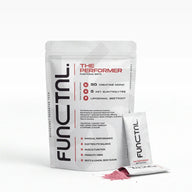
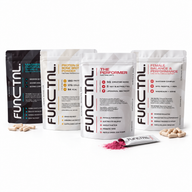
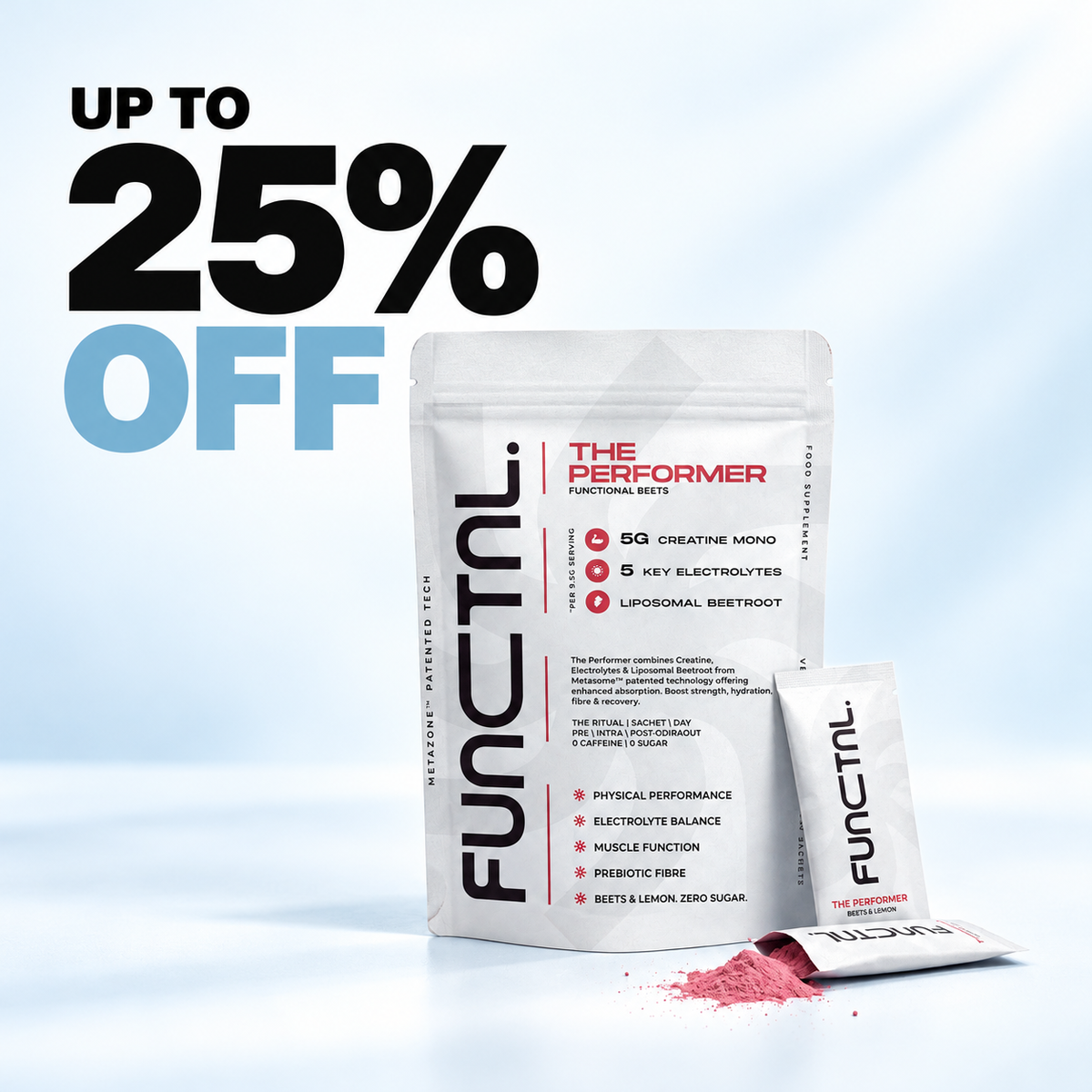
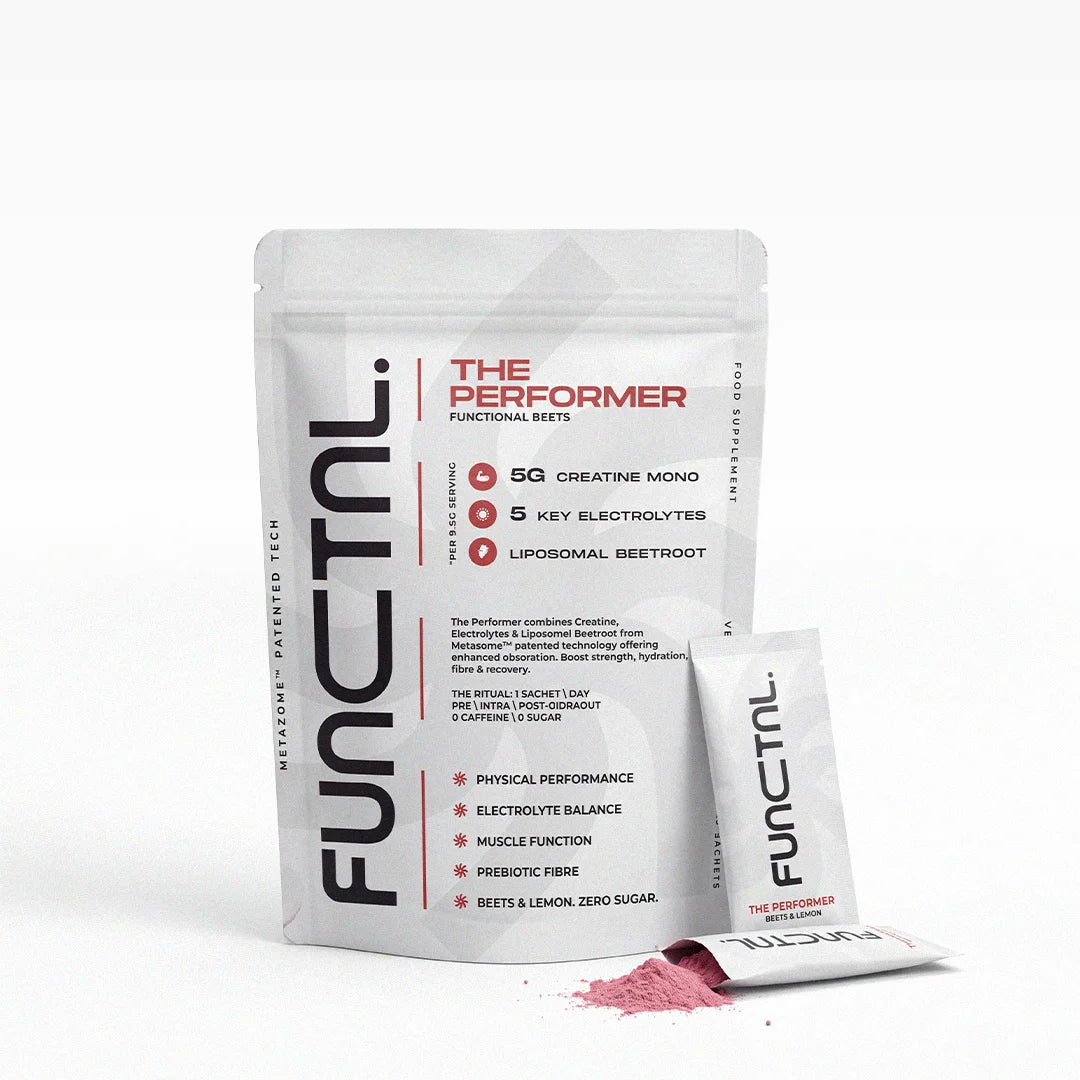
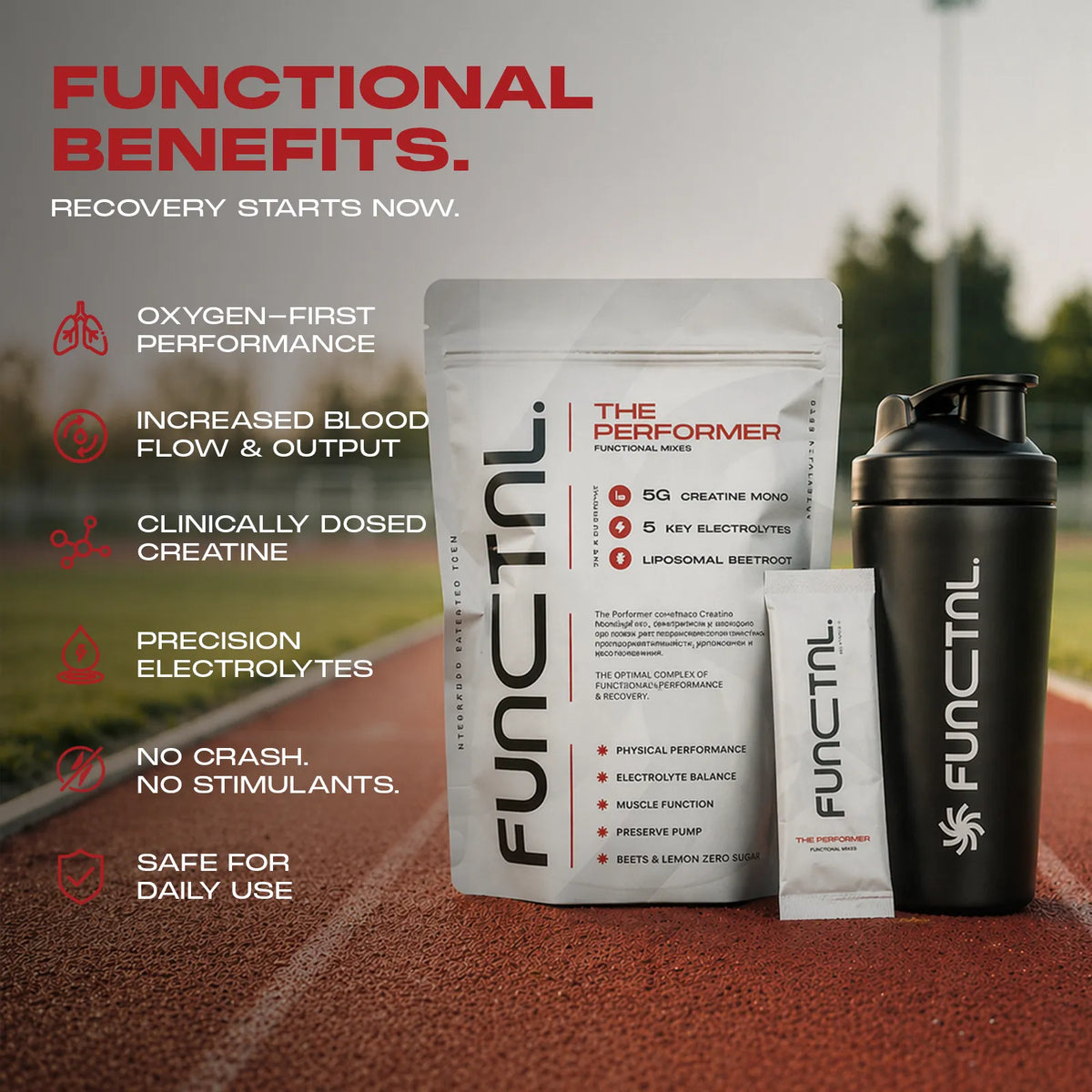
The Performer is not a juice, so it has no millilitre equivalent. Each 9.5 g sachet provides 2,500 mg of liposomal beetroot, 5,000 mg of creatine monohydrate, 300 mg of potassium, 149 mg of magnesium, 175 mg of sodium and 10 µg of vitamin B12, with 0 g of sugar and 0 mg of caffeine. A pack holds 15 sachets.
Here is what only we can say: we do not state the nitrate content of the beetroot, so we cannot convert a sachet into a volume of juice or compare it with the research doses above. It suits people who want beetroot with creatine and electrolytes, not those who need a stated nitrate dose.
"Doesn't taste sweet." Blair Munhezi, Boxer and Personal Trainer
Frequently asked questions
Is a beetroot juice shot better than a glass of juice?
A shot is easier to dose. A 70 ml concentrated shot contains 400 mg of nitrate, while ordinary juice contains about 800 mg per litre and often does not state its amount. A glass is better for food and 5 a day, and it counts as 1 portion.
How much whole beetroot equals one shot?
About one large beetroot, or 200 g, gives roughly the 400 mg of nitrate in one 70 ml shot, according to the Australian Institute of Sport. The same amount of nitrate comes from about 500 ml of fresh juice, or around 150 g of rocket or baby spinach.
Do you need to load beetroot juice for several days?
Not for everyday use. Researchers use loading, 350 to 650 mg of nitrate a day for 3 to 15 days plus a dose before the event, mainly for highly trained athletes where gains are harder to obtain. A single dose 2 to 3 hours before exercise is the simpler option.
Does mouthwash affect beetroot juice?
Yes. The Australian Institute of Sport advises avoiding mouthwash and chewing gum with beetroot juice, because they interfere with its benefit. Antibacterial mouthwash can reduce the mouth bacteria that help convert nitrate, so leave a sensible gap around your dose.
Which other foods contain as much nitrate as beetroot?
Beetroot and beetroot juice, celery, lettuce, rocket and spinach are all classed as very high in nitrate, at around 2,500 mg per kg of fresh vegetable. Eating a variety of these gives you nitrate in food form, alongside fibre and other nutrients.
Can you have The Performer and beetroot juice on the same day?
Yes, but count your totals. The Performer provides 2,500 mg of liposomal beetroot and 175 mg of sodium per sachet, and juice adds sugars. If you take blood pressure medicine or have a medical condition, speak to your GP before combining them.
Does The Performer replace beetroot juice?
No. Juice counts towards your 5 a day, up to 150 ml, and a supplement does not. The Performer has 0 g of sugar and adds creatine and electrolytes, but its nitrate is not stated. Use it as an addition to your diet, not a swap for vegetables.
Sources
- Australian Institute of Sport. Sports Supplement Framework: beetroot juice and nitrate fact sheet (practitioner version).
- Australian Institute of Sport. Sports Supplement Framework: beetroot juice (nitrates) athlete infographic.
- NHS. 5 A Day: what counts? Juice and smoothies (portion sizes).
- Kapil V, Khambata RS, Robertson A, Caulfield MJ, Ahluwalia A (2015). Dietary nitrate provides sustained blood pressure lowering in hypertensive patients: a randomized, phase 2, double-blind, placebo-controlled study. Hypertension 65(2):320-327.


