
joints
Joint Supplements UK: What to Look For and What to Skip

By FUNCTNL Team · Last updated 12 November 2026
The best joint supplements in the UK show a dose for every ingredient, compare those doses honestly with trial amounts and tell you who should avoid them. Research on curcumin, boswellia and oral hyaluronic acid has been in people with knee osteoarthritis, over 4 weeks or more. FUNCTNL Joint & Gut Synergy lists all six of its doses.
Key takeaways
- Joint pain has many causes, and the NHS advises seeing your GP for persistent symptoms of osteoarthritis.
- A 2024 meta-analysis found Curcuma longa improved knee osteoarthritis pain more than placebo over 4 to 6 weeks, with similar results under and over 1,000 mg a day.
- A 2020 meta-analysis of 7 trials with 545 people found boswellia improved osteoarthritis pain and function, with use for at least 4 weeks.
- A 12-month trial of oral hyaluronic acid used 200 mg a day, four times the 50 mg in one serving of Joint & Gut Synergy.
- The UK Committee on Toxicity found reasonable evidence linking turmeric supplements with rare liver injury.
Walk into any shop and the joint supplement shelf makes big promises, usually without the doses that would let you check them. If your joints are sore, you deserve better than a front label. This article gives you six criteria, a table of the main ingredients, the red flags to skip and a label checklist. It also maps FUNCTNL Joint & Gut Synergy against those criteria, including where it falls short. For a runner-specific view, read our article on joint supplements for runners.
What should you look for in joint supplements in the UK?
A good joint supplement states every dose in mg, sets those doses against the amounts used in trials, and backs each ingredient with human evidence. It also keeps to authorised claims and gives clear safety advice. Use these six criteria to compare any product.
- Every ingredient has a stated dose in mg, with no proprietary blend.
- The dose is close to the amount used in trials, or the brand says it is not.
- Each ingredient has human trial evidence, not only lab or animal studies.
- Health claims are limited to authorised nutrient claims, such as vitamin D and normal bones.
- Contaminant testing is stated, because supplement quality varies.
- Safety advice names who should avoid it and which medicines to check.
What types of joint supplement are there?
Most joint supplements use one or more of four ingredient groups: curcumin, boswellia, oral hyaluronic acid, and the nutrients vitamin D3 and magnesium. The table shows what each is known for and what to watch out for. Trial doses come from the cited studies and differ between products.
| Type | Best known for | Typical trial dose (mg a day) | Watch out for |
|---|---|---|---|
| Curcumin or turmeric | Knee osteoarthritis pain trials | Under and over 1,000, similar results | Rare liver injury reports in the UK |
| Boswellia | Osteoarthritis pain and function trials | Varies by extract; check the % AKBA | Used for at least 4 weeks in trials |
| Oral hyaluronic acid | Knee symptoms in small trials | 200 in a 12-month trial | Small trials; doses vary |
| Vitamin D3 and magnesium | Authorised claims for normal bones and muscle function | Per label (µg or mg) | Count your total from all supplements |
Do joint supplements help with joint pain?
Some have been linked with less knee osteoarthritis pain in trials, but a supplement is not a first step. The NHS says to see your GP for persistent symptoms of osteoarthritis, and lists exercise, losing weight slowly and paracetamol among its options (NHS).
For curcumin, a 2024 meta-analysis found Curcuma longa improved knee osteoarthritis pain scores more than placebo over 4 to 6 weeks, with high variation between trials (Hidayat et al., 2024). For boswellia, a 2020 meta-analysis of 7 trials with 545 people found benefits for pain and function, with use for at least 4 weeks (Yu et al., 2020).
For oral hyaluronic acid, a 12-month double-blind trial gave 200 mg a day to people with knee osteoarthritis (Tashiro et al., 2012). We found no human joint trial of black ginger. All of these studies involved people with a diagnosed condition, and none tested our formula.
What should you avoid in a joint supplement?
- Proprietary blends that hide the dose of each ingredient.
- Ingredients listed with no amount in mg.
- Claims that a capsule will rebuild cartilage or end arthritis.
- Headline numbers such as "4x absorption" with no published human data.
- Testimonials about arthritis or knee pain, which imply a medical result.
- A long ingredient list at tiny doses that matches no trial.
How do you check a joint supplement label?
- Find the serving size and the number of servings per pack.
- Read the dose of each ingredient in mg or µg.
- Compare each dose with the trial amounts in the table above.
- Check vitamin D and magnesium against the NRV percentages.
- Look for third-party testing and who made the product.
- Read the warnings, especially for medicines and liver conditions.
- Add up vitamin D and magnesium from every supplement you take.
Is it safe to take joint supplements?
Generally yes, but one point is specific to curcumin. The UK Committee on Toxicity found reasonable evidence for a link between turmeric supplements and rare cases of liver injury, including at levels below the acceptable daily intake (COT, 2024). Do not exceed the recommended daily intake.
Who should avoid them?
- Anyone with a liver, gallbladder or bile duct condition should avoid curcumin unless their GP agrees.
- Anyone taking medication, especially blood thinners, should speak to their GP or pharmacist first.
- Anyone with a hot, red, swollen joint or sudden severe pain should see a doctor, not a supplement.
Stop taking it and see your GP if you notice yellow skin or eyes, dark urine or stomach pain. Food supplements should not replace a varied, balanced diet. Speak to your GP before use if you are pregnant, breastfeeding, taking medication or have a medical condition.
How FUNCTNL Joint & Gut Synergy meets these criteria
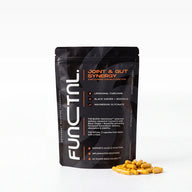
Each serving of 2 capsules provides 250 mg of liposomal curcumin, 100 mg of boswellia extract (30% AKBA), 50 mg of black ginger, 50 mg of hyaluronic acid, 1,000 IU (25 µg) of vitamin D3 (500% NRV) and 80 mg of magnesium bisglycinate (21% NRV). Vitamin D contributes to the maintenance of normal bones and normal muscle function, and magnesium contributes to a reduction of tiredness and fatigue (GB NHC register).
| Criterion | Joint & Gut Synergy |
|---|---|
| Dose stated for every ingredient | Yes, six ingredients, no proprietary blend |
| Dose close to trial amounts | Mixed: hyaluronic acid is 50 mg against 200 mg in the trial; trial curcumin forms differ |
| Human evidence for each ingredient | Trials exist for curcumin, boswellia and hyaluronic acid; none for this formula; none found for black ginger |
| Claims limited to authorised nutrients | Yes, only vitamin D and magnesium |
| Safety advice | Names liver, medication and pregnancy cautions |
Here is what only we can say: we chose six ingredients with every dose on the label, rather than a long list at tiny doses. A pack holds 60 capsules, or 30 servings. Take 2 capsules with breakfast. It is vegetarian, gluten-free, dairy-free, soy-free and sugar-free.
"My go-to as a regular runner." M Pirani, London Marathon Runner
Shop FUNCTNL Joint & Gut Synergy
Does FUNCTNL deliver outside the UK?
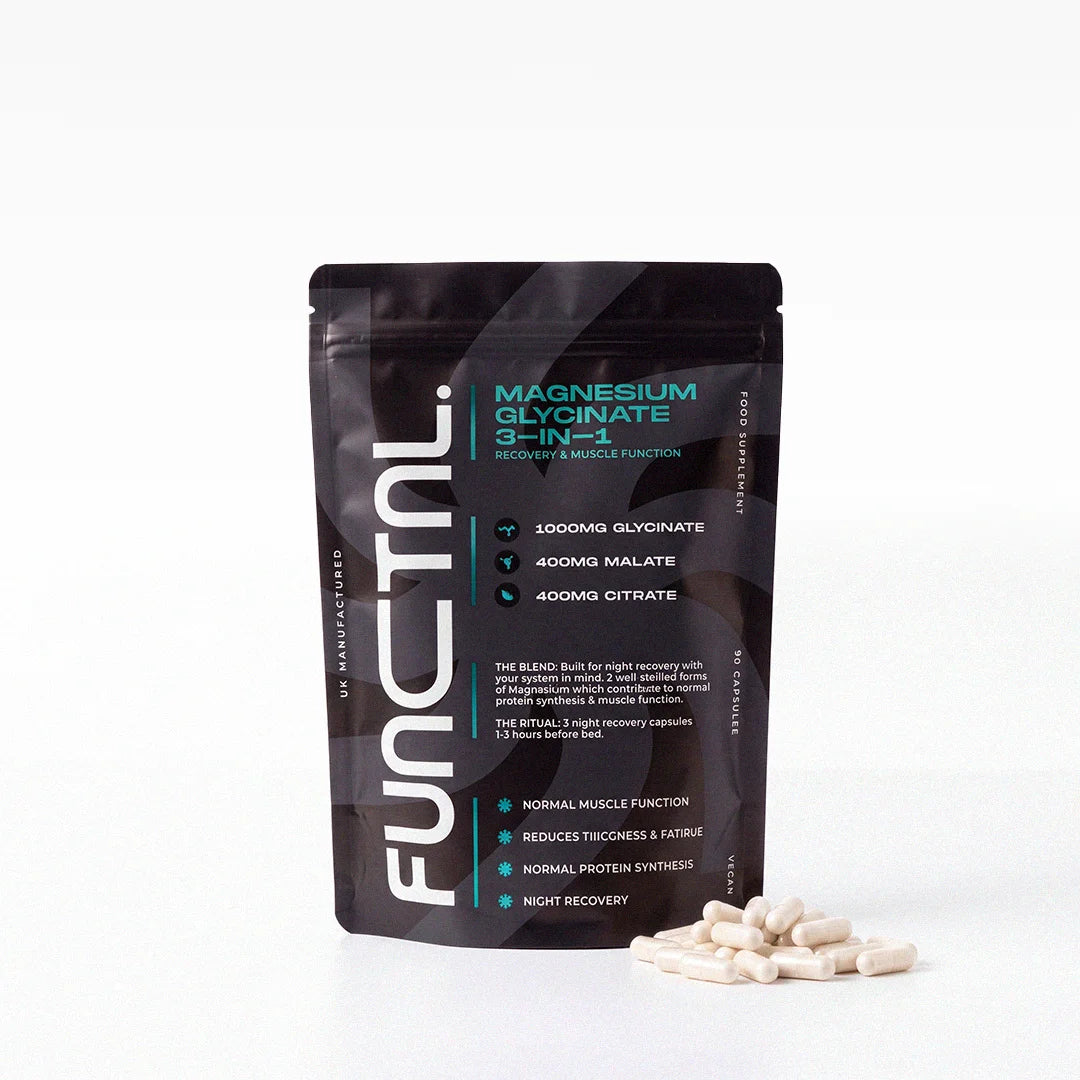
Yes. FUNCTNL delivers Magnesium Glycinate 3 in 1 to Dubai, Kuwait, Malta, North Cyprus, Ghana, Tanzania, Kenya, Uganda and Bangladesh, as well as across the UK. Orders are open for all of these destinations on our website.
Delivery options and costs for your country are confirmed at checkout.
Frequently asked questions
Can you take Joint & Gut Synergy with Magnesium 3-in-1?
Count the magnesium first. Joint & Gut Synergy gives 80 mg per serving and Magnesium 3-in-1 gives 384 mg, a total of 464 mg, above the 400 mg the NHS says is unlikely to cause harm.
Speak to your GP or pharmacist before combining them, and check your vitamin D total too.
How long should you take a joint supplement before judging it?
The curcumin trials ran for 4 to 6 weeks and the boswellia trials for at least 4 weeks, so give a supplement a similar period. Keep a simple diary of your joint comfort and training. If pain worsens or does not settle within a few weeks, see your GP.
Can you take Joint & Gut Synergy with blood thinners?
Speak to your GP or pharmacist first. Curcumin supplements can interact with some medicines, including blood thinners, and the UK Committee on Toxicity has raised liver concerns about turmeric supplements. Do not stop or change any prescribed medicine because of a supplement.
What is liposomal curcumin?
Liposomal curcumin is curcumin wrapped in liposomes, tiny spheres made from fats. Joint & Gut Synergy uses MetaZome technology for its 250 mg of curcumin. Liposomal delivery is designed to help absorption, but the trials above used other forms of curcumin, so we make no claim about uptake.
Can you open the capsules of Joint & Gut Synergy?
Yes. If you prefer not to swallow capsules, open them, pour the powder into a smoothie, blend it and drink it straight away. Curcumin is fat soluble, so taking it with food, such as breakfast, is an easy habit to keep. Do not exceed 2 capsules a day.
Is Joint & Gut Synergy suitable for vegetarians?
Yes. It is suitable for vegetarians and free from gluten, dairy, soy and sugar, with no artificial colouring and no known allergens. Check the full label if you follow a specific diet, and speak to your GP before use if you are pregnant, breastfeeding or take medication.
Sources
- Hidayat R, Parlindungan F, Nisa JI, Mahendra AI, Indika MI (2024). Efficacy of Curcuma longa in relieving pain symptoms of knee osteoarthritis patients: a systematic review and meta-analysis of clinical trials. Journal of Rheumatic Diseases 32(1):17-29.
- Yu G, Xiang W, Zhang T, Zeng L, Yang K, Li J (2020). Effectiveness of Boswellia and Boswellia extract for osteoarthritis patients: a systematic review and meta-analysis. BMC Complementary Medicine and Therapies 20:225.
- Tashiro T, Seino S, Sato T, Matsuoka R, Masuda Y, Fukui N (2012). Oral administration of polymer hyaluronic acid alleviates symptoms of knee osteoarthritis: a double-blind, placebo-controlled study over a 12-month period. The Scientific World Journal 2012:167928.
- Committee on Toxicity (2024). Statement on the potential risk to human health of turmeric and curcumin supplements (COT/2024/07).
- NHS. Osteoarthritis: treatment.
- UK Government. Great Britain nutrition and health claims (NHC) register.


